
Powered by Best Colleges
Quick answer
The best graduate schools for veterans in 2026 combine three things: Yellow Ribbon participation (or full in-state coverage), dedicated veteran support offices, and formats built for working adults. Syracuse University, Arizona State University, and George Mason University lead the list for pairing generous GI Bill coverage with strong graduate program quality. Still, public options like UMSL, CUNY SPS, and Ohio State offer comparable value at a lower total cost.
Why Where You Go to Graduate School Matters More for Veterans
Choosing a graduate school on the GI Bill isn’t the same decision a traditional applicant makes. Benefits are finite — most veterans have 36 months of Post-9/11 GI Bill entitlement, and once it’s used, it’s gone. That reality changes the calculus: a program’s Yellow Ribbon status, its willingness to accept transfer credit or military training, and whether it offers formats that survive a PCS move or a deployment can matter as much as its academic ranking.
This list focuses specifically on graduate-level fit. Some schools that dominate general “best for vets” rankings are undergraduate-heavy; the 15 institutions below were selected because they have built graduate-specific infrastructure. We’re talking dedicated advisors, Yellow Ribbon agreements that extend to master’s and doctoral programs, and course formats designed around adult and military students, not just 18-year-old freshmen.
How We Chose These Schools
Each school on this list was evaluated against four factors that matter specifically for graduate-level military and veteran students:
- GI Bill and Yellow Ribbon coverage: Whether the school participates in the Yellow Ribbon Program at the graduate level, and whether public in-state tuition is extended to veterans regardless of home state.
- Program format flexibility: Availability of online, hybrid, part-time, and accelerated formats suited to working adults, active-duty schedules, and frequent relocation.
- Dedicated veteran support: Presence of a standalone office, resource center, or advising structure specifically for military-connected graduate students.
- Career and program relevance: Depth of graduate offerings in fields veterans commonly pursue, including business, public administration, cybersecurity, and policy.
For current GI Bill approval status and Yellow Ribbon participation, always confirm directly through the VA’s GI Bill Comparison Tool before enrolling — approval status and funding caps can change year to year.
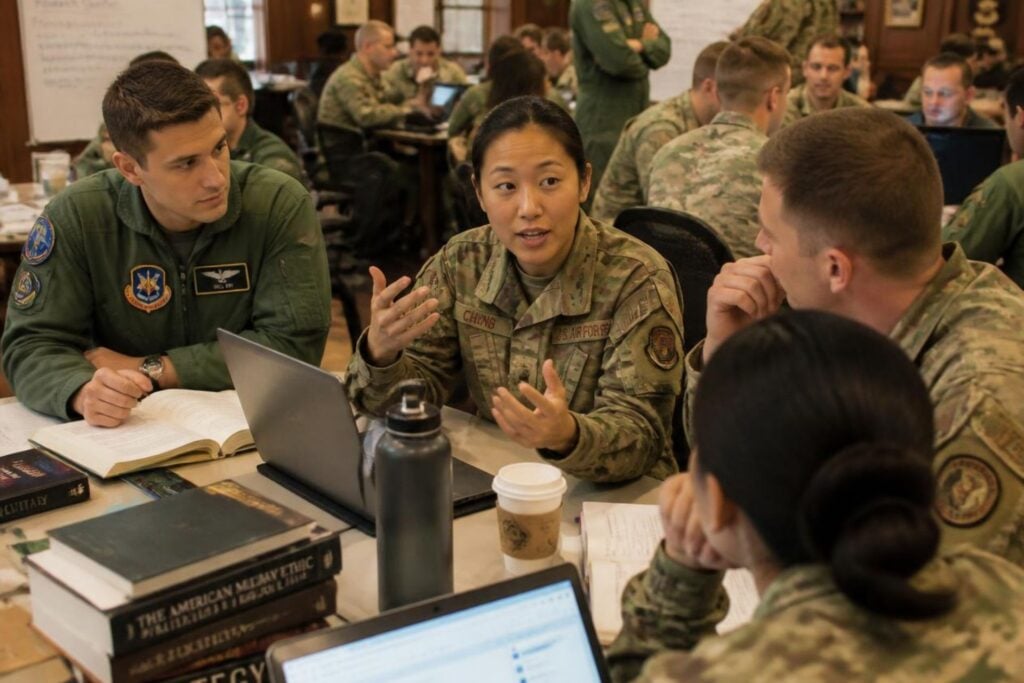
The 15 Best Graduate Schools for Veterans and Military Students
Rank 1. Syracuse University
Syracuse, NY — Private
Syracuse built its reputation on veteran services long before “military-friendly” became a marketing label. The D’Aniello Institute for Veterans and Military Families (IVMF) anchors campus-wide programming, and the Office of Veteran and Military Affairs (OVMA) serves as a single point of contact for benefits, advising, and community. Syracuse is a 100% Yellow Ribbon school with no cap on participating students, so Post-9/11 GI Bill users at the Whitman School of Management, Maxwell School of Citizenship and Public Affairs, and the School of Information Studies can typically graduate with $0 out-of-pocket tuition.
Rank 2. Arizona State University
Tempe, AZ — Public
ASU pairs a large, well-established online infrastructure with graduate programs that consistently rank among the top online offerings nationally. That combination matters for military students juggling deployments, PCS moves, and irregular schedules. ASU Online lets students start terms multiple times a year and move at a pace that fits military life. ASU is GI Bill-approved, offers in-state tuition rates to eligible veterans regardless of home state under federal law, and runs a dedicated Pat Tillman Veterans Center with academic coaching built specifically for military-connected graduate students.
Rank 3. George Mason University
Fairfax, VA — Public
Positioned minutes from the Pentagon and a dense concentration of federal agencies and defense contractors, George Mason draws heavily on a military-connected student population. It builds graduate offerings, particularly in cybersecurity, public policy, and conflict analysis, around that audience. The Office of Military Services provides benefits certification, a Veterans and Military Resource Center, and priority registration. Mason participates in the Yellow Ribbon Program, which matters for out-of-state veterans since Virginia’s proximity to defense hubs draws heavily from outside the state.
Rank 4. Purdue University Global
West Lafayette, IN — Public, fully online
Purdue Global was purpose-built as a fully online extension of Purdue University for working adults, and military students make up a substantial share of its graduate population. The school offers a tuition guarantee that locks in rates for the length of a program, which is useful for veterans budgeting GI Bill months against a fixed timeline, plus a dedicated Military Advantage team and credit for military training and coursework (JST/CCAF evaluation) that can shorten degree paths.
Rank 5. University of Southern California
Los Angeles, CA — Private
USC’s Veterans Resource Center is one of the longest-running and most heavily resourced in the country. The university has a decades-long relationship with military-connected students dating back to its VITA (Veterans in Transition and Academia) program. USC participates fully in Yellow Ribbon, which offsets tuition well above the private-school GI Bill cap at programs like the Marshall School of Business and the Sol Price School of Public Policy. Los Angeles’s concentration of defense, aerospace, and entertainment employers gives graduates strong regional placement.
Rank 6. Columbia University
New York, NY — Private (Ivy League)
Columbia’s tuition sits far above the private-school GI Bill cap. Still, its Yellow Ribbon agreement is one of the most generous in the Ivy League, and the School of General Studies has admitted veterans and nontraditional students as a core part of its mission since 1947. Columbia’s Veteran Affairs Office and the Columbia University Employer Alliance for military veterans connect graduate students to Wall Street, consulting, and public-sector employers. This is a fit for veterans targeting elite-tier credentialing in business, international affairs, or journalism.
Rank 7. Georgetown University
Washington, DC — Private
Georgetown’s location inside the federal policy ecosystem makes its graduate programs — especially the McDonough School of Business MBA and the Walsh School of Foreign Service — a natural landing spot for veterans transitioning into government affairs, defense contracting, or international relations. The Georgetown Veterans Office coordinates benefits processing across schools, and the university is a full Yellow Ribbon participant. A large peer community of prior-service students, including many field-grade officers, is a distinguishing feature of the cohort experience here.
Rank 8. Texas A&M University
College Station, TX — Public
Texas A&M’s Corps of Cadets and century-plus military tradition translate into one of the largest and most institutionally embedded veteran-support infrastructures of any public flagship. The Hazlewood Act (a Texas state benefit) can stack with the Post-9/11 GI Bill for eligible veterans and dependents, materially lowering costs beyond federal benefits alone. Graduate programs in the Mays Business School and the Bush School of Government & Public Service both draw heavily from a military-connected applicant pool, and the university’s Veteran Resource & Support Center offers dedicated academic advising.
Rank 9. The Ohio State University
Columbus, OH — Public
Ohio State supports more than 2,000 military-affiliated students through its Office of Military and Veterans Services, with priority registration, a Veterans House residential community, and benefits counselors who work specifically with graduate and professional students. The Fisher College of Business and the John Glenn College of Public Affairs both offer formats — including part-time and executive tracks — designed around working professionals, which suits veterans already employed while completing a degree.
Rank 10. University of Missouri–St. Louis (UMSL)
St. Louis, MO — Public
UMSL regularly appears on veteran-focused rankings for a combination of low relative cost, GI Bill-friendly tuition structuring, and a genuinely accessible online graduate catalog. It’s a strong option for veterans who want a public-university price point without sacrificing program breadth — UMSL offers graduate degrees across business, criminology, education, and public policy with formats built for adult and military learners, plus a Veterans Center that handles benefits certification in-house.
Rank 11. CUNY School of Professional Studies
New York, NY — Public
CUNY SPS was designed around working adults from the outset, which lines up closely with the scheduling realities most veterans face: full-time jobs, family obligations, and benefits that reward finishing on time. Programs run in accelerated, largely asynchronous online formats, and New York’s relatively low public-university tuition means many veterans use only a fraction of their GI Bill entitlement to complete a master’s degree. CUNY SPS also holds Yellow Ribbon status for programs where costs exceed the cap.
Rank 12. Norwich University
Northfield, VT — Private (Senior Military College)
As the oldest of the nation’s six senior military colleges, Norwich has built its entire institutional identity around military and veteran education since 1819. Its online Graduate & Continuing Studies division was one of the earliest to specialize in programs directly relevant to a transitioning service member’s background — cybersecurity, information security, and leadership are all offered in structured cohort formats with classmates who are overwhelmingly military-connected. Norwich participates in Yellow Ribbon and offers additional institutional grants for veterans.
Rank 13. American Public University System (APUS/AMU)
Charles Town, WV — Private, fully online
Built originally to serve active-duty and reserve-component students, APUS (which includes American Military University) offers some of the lowest graduate tuition rates among GI Bill-approved schools and does not charge active-duty service members out-of-pocket tuition for undergraduate coursework, with reduced graduate rates as well. Course starts run monthly, a meaningful advantage for students working around deployment and training schedules, and the curriculum leans heavily toward national security, intelligence, and military history at the graduate level.
Rank 14. Western Governors University (WGU)
Salt Lake City, UT — Private, nonprofit, fully online
WGU’s competency-based model lets students move through coursework as fast as they can demonstrate mastery rather than sitting through a fixed semester calendar — a structure that rewards veterans with relevant work experience and can meaningfully shorten time-to-degree. Tuition is charged by six-month term rather than by credit, so accelerating coursework stretches GI Bill benefits further. WGU has a dedicated Military and Veteran Student Center and evaluates military training for credit.
Rank 15. Old Dominion University
Norfolk, VA — Public
Sitting in the middle of the largest concentration of active-duty personnel and military installations in the country, Old Dominion has built graduate programs, advising infrastructure, and a Military Connection Center specifically around Hampton Roads’ military community. Its online graduate catalog is unusually deep for a regional public university, and ODU participates in Yellow Ribbon while also honoring in-state tuition for veterans and dependents statewide. Programs in maritime and supply chain management, cybersecurity, and public administration draw directly on the region’s naval and logistics economy.
At-a-Glance Comparison
| School | Yellow Ribbon | Format | Standout Grad Programs |
| Syracuse University | Yes — uncapped | On-campus, hybrid, online | MBA, Public Administration, Information Management |
| Arizona State University | Yes | Online, on-campus, hybrid | MBA, Engineering, Public Policy, Social Work |
| George Mason University | Yes | On-campus, hybrid, online | Cybersecurity, Public Policy, Conflict Analysis & Resolution |
| Purdue University Global | Yes | 100% online | MBA, IT & Cybersecurity, Criminal Justice, Human Services |
| University of Southern California | Yes | On-campus, online, hybrid | MBA, Public Policy, Social Work, Engineering |
| Columbia University | Yes | On-campus | MBA, International & Public Affairs (SIPA), Journalism |
| Georgetown University | Yes | On-campus, hybrid | MBA, Foreign Service, Security Studies |
| Texas A&M University | Yes | On-campus, online, hybrid | MBA, Public Service & Administration, Engineering |
| The Ohio State University | Yes | On-campus, online, hybrid | MBA, Public Affairs, Logistics & Supply Chain |
| University of Missouri–St. Louis (UMSL) | Yes | Online, on-campus, hybrid | MBA, Criminology & Criminal Justice, Public Policy Administration |
| CUNY School of Professional Studies | Yes | Online, accelerated | Data Science, Disability Studies, Business Management |
| Norwich University | Yes | Online, cohort-based | Information Security & Assurance, Cybersecurity, Public Administration |
| American Public University System (APUS/AMU) | Limited/program-dependent | 100% online, monthly starts | Intelligence Studies, National Security Studies, Military History |
| Western Governors University (WGU) | Program-dependent | 100% online, competency-based | MBA, IT Management, Healthcare Leadership, Education |
| Old Dominion University | Yes | On-campus, online, hybrid | Maritime & Supply Chain Management, Cybersecurity, Public Administration |
How to Maximize Your GI Bill Benefits in Graduate School
Confirm Yellow Ribbon status for your specific program.
Yellow Ribbon agreements are sometimes limited to certain colleges within a university or capped at a specific number of students per year. Confirm with the graduate program’s certifying official — not just the university’s general admissions page — that your intended program is covered.
Compare online-only versus hybrid housing allowance rates.
Fully online enrollment pays a flat national monthly housing allowance, while any in-person component unlocks the full local BAH rate for the school’s ZIP code. For veterans near high-cost metro areas, even one required in-person residency or intensive can significantly increase monthly benefits.
Ask what military training counts toward the degree.
Graduate programs evaluate military experience less consistently than undergraduate programs do. Programs in cybersecurity, logistics, healthcare administration, and project management are the most likely to accept relevant certifications or professional military education toward requirements — ask directly rather than assuming credit won’t transfer.
Sequence your benefits deliberately.
Veterans with fewer than 36 months of remaining entitlement should map out exactly how many months a program requires before enrolling. Competency-based or accelerated formats (like WGU’s six-month term structure) can stretch remaining benefits across more coursework than a traditional semester calendar.
Frequently asked questions
Do graduate programs cost more under the Post-9/11 GI Bill than undergraduate programs?
The GI Bill doesn’t distinguish between undergraduate and graduate coursework — it pays the same way at any degree level. At public schools, in-state tuition and fees are covered in full. At private and foreign schools, the benefit is capped at a set annual maximum (roughly $30,900 for the 2026–2027 academic year), which is why Yellow Ribbon participation matters more for graduate programs at private universities, where per-credit costs are typically higher.
Can I use the Yellow Ribbon Program for a master’s or doctoral degree?
Yes. Yellow Ribbon applies to any degree level at a participating school, including master’s, doctoral, and professional programs. Some schools cap the number of Yellow Ribbon seats or limit participation to specific colleges within the university, so it’s worth confirming eligibility for your specific graduate program directly with the school’s certifying official before enrolling.
Does the monthly housing allowance (MHA) change for graduate students?
MHA is based on enrollment status and course format rather than degree level. Students taking classes with any in-person component receive the full local BAH rate for the school’s ZIP code; fully online students receive a flat national rate, which was roughly half the average BAH rate as of the 2025–2026 academic year. Part-time enrollment reduces the housing allowance proportionally.
Will my military training or experience count toward a graduate degree?
Sometimes, though less often than at the undergraduate level. Most schools evaluate a Joint Services Transcript (JST) primarily for undergraduate credit. Still, some graduate programs, particularly in cybersecurity, logistics, healthcare, and project management, accept relevant certifications or professional military education toward elective or foundational requirements. Ask the graduate admissions office directly which credentials they evaluate.
What’s the difference between a “military-friendly” label and a Yellow Ribbon school?
“Military-friendly” is typically a marketing designation self-reported to ranking organizations and doesn’t guarantee any specific financial benefit. Yellow Ribbon is a formal VA agreement in which the school voluntarily contributes funds toward tuition above the GI Bill cap, and the VA matches that contribution dollar for dollar. Always verify Yellow Ribbon participation and GI Bill approval directly through the VA’s GI Bill Comparison Tool rather than relying on a school’s own marketing claims.
Should active-duty service members prioritize different schools than veterans?
Often, yes. Active-duty students using Tuition Assistance (TA) instead of, or alongside, the GI Bill benefit most from schools with low per-credit TA-capped rates, flexible drop/withdrawal policies for deployment, and asynchronous online formats that survive PCS moves. Veterans who have separated and are using the Post-9/11 GI Bill full-time can weigh campus-based programs and higher-cost private schools more heavily, since Yellow Ribbon and full-time MHA make them more financially accessible.
Closing
The bottom line
There is no single “best” graduate school for every veteran; the right choice depends on how much GI Bill entitlement remains, whether Yellow Ribbon coverage extends to the specific program, and how much flexibility a service member’s schedule requires. Private research universities like Syracuse, Georgetown, and Columbia offer strong outcomes and full tuition coverage through Yellow Ribbon. Still, public options like Arizona State, Ohio State, and UMSL deliver comparable value with lower total cost and less dependence on capped Yellow Ribbon seats. Whichever school makes the list, verify GI Bill approval and Yellow Ribbon participation directly through the VA before enrolling.