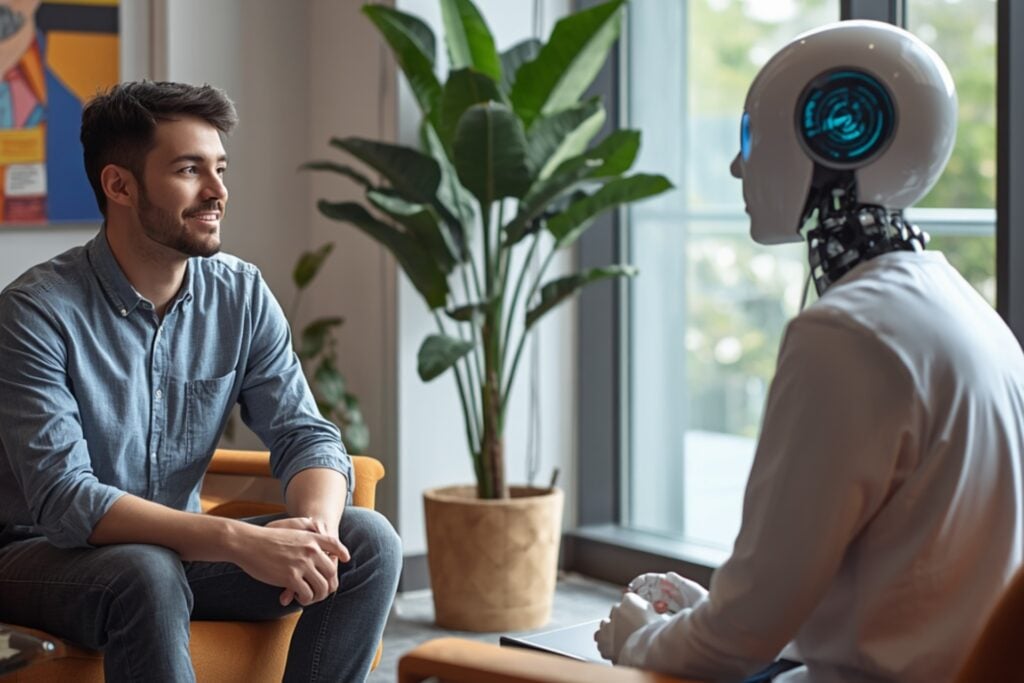
The Mental Health Angle: AI Wellness Tools Designed For The Specific Stress Patterns Of Grad Students
Share this on:


Find your perfect college degree
In this article, we will be covering...
Why Grad Student Stress Is Its Own Category
Graduate school stress is not a louder version of undergraduate stress. It occupies a different psychological landscape entirely. It is shaped by prolonged uncertainty, social isolation, financial precarity, and an identity that becomes fused with academic performance in ways that are difficult to untangle.
The American Psychological Association has consistently reported that graduate students experience depression and anxiety at rates six times higher than the general population. A landmark study published in Nature Biotechnology found that 41% of PhD students scored as having moderate-to-severe anxiety, compared to 6% in the general population. These are not marginal numbers.
The stressors driving those numbers are specific:
Chronic, ambiguous timelines. Unlike undergraduate programs with fixed four-year structures, graduate degrees, especially PhDs, can stretch unpredictably. A student who entered a program expecting to finish in five years may find themselves in year seven with no clear end in sight. This kind of open-ended uncertainty is acutely taxing on the nervous system.
Evaluative relationships with power asymmetry. The advisor-advisee relationship is unlike almost any other professional relationship. An advisor controls a student’s funding, career trajectory, publication record, and day-to-day work environment. When that relationship is strained through neglect, conflict, or explicit harm, the student often has no safe off-ramp.
Imposter syndrome with institutional reinforcement. Most graduate students were high achievers before they arrived. Graduate school is frequently the first environment where they are surrounded by people just as capable, in a system designed to evaluate and rank. The psychological toll of this shift is profound and underappreciated.
Publication pressure and invisible labor. The pressure to produce publishable research is enormous, but the actual labor of doing it through failed experiments, revise-and-resubmit cycles, and rejected grants is largely invisible and uncelebrated.
Financial stress layered onto academic stress. Most graduate stipends fall below the cost of living in university towns and cities. Financial stress does not just exist alongside academic stress; it compounds it.
AI wellness tools, when designed with these dynamics in mind, can offer something valuable: available, judgment-free, responsive support between therapy appointments, during a 2 a.m. data crisis, or in the days before a dissertation defense.
What Are AI Wellness Tools?
AI wellness tools are software applications that use artificial intelligence, including large language models, machine learning algorithms, and behavioral analysis, to support users’ mental and emotional health. They are not the same as traditional therapy apps (which connect users with human therapists) or general mindfulness apps (which rely on pre-recorded audio). AI wellness tools generate dynamic, personalized responses, track behavioral and mood data over time, and can adapt their support based on what a user reports experiencing.
Categories of AI wellness tools include:
| Category | What It Does | Example Use Case |
| AI Chatbots / Conversational Agents | Provide real-time text-based emotional support using LLM technology | Processing anxiety the night before a qualifying exam |
| Mood Tracking with AI Analysis | Log emotional states; AI identifies patterns and triggers | Discovering that anxiety spikes every Sunday evening |
| CBT-Based AI Coaches | Guide users through Cognitive Behavioral Therapy exercises | Challenging distorted thinking after a paper rejection |
| Sleep and Stress Biometric Tools | Use wearable data + AI to assess physiological stress | Tracking how dissertation crunch periods affect sleep |
| Journaling Apps with AI Reflection | Prompt and respond to journal entries with personalized insight | Processing advisor conflict through guided writing |
The Specific Stress Patterns AI Tools Can Address
Before reviewing specific tools, it helps to name the stress patterns that are most common in graduate programs. The best AI wellness tools are those that match one or more of these patterns.
1. Anticipatory Anxiety Around Milestones
Qualifying exams, dissertation proposals, conference presentations, and thesis defenses generate a specific type of anxiety: anticipatory, future-focused, and prone to catastrophizing. This is distinct from generalized anxiety. It has a defined target.
What helps: Structured worry exposure techniques, grounding exercises, and CBT-based thought records that interrupt the catastrophizing loop.
2. Chronic Low-Grade Stress from Ambiguity
“Am I making progress?” “Is my advisor happy with my work?” “Will I finish on time?” These questions don’t have clear answers in most graduate programs. The result is a persistent background hum of low-grade stress that accumulates over the years.
What helps: Mood logging to build self-awareness, short mindfulness practices to interrupt ruminative thought, and journaling to externalize and reframe ambiguous fears.
3. Relational Stress (Advisor, Committee, Peers)
The power dynamics of graduate school create relational stress that is qualitatively different from ordinary workplace conflict. Students frequently feel they cannot speak openly about these relationships to anyone within their institution.
What helps: Conversational AI tools that provide a judgment-free space to process interpersonal frustration, and apps that help users prepare for difficult conversations.
4. Identity Disruption and Imposter Syndrome
Many graduate students experience a profound sense that they don’t belong — even as they produce work that clearly demonstrates competence. This is particularly acute among first-generation students, underrepresented groups, and international students navigating cultural adjustment alongside academic pressure.
What helps: CBT and Acceptance and Commitment Therapy (ACT) exercises targeting self-critical thought patterns; journaling prompts designed to surface evidence against imposter beliefs.
5. Burnout and Motivation Loss
Late-stage PhD students in particular often experience a flattening of motivation — not depression exactly, but a profound depletion of the energy and curiosity that brought them to graduate school. Burnout is distinct from sadness, and it responds to different interventions.
What helps: Behavioral activation tools, value-clarification exercises, and habit-tracking that reconnects daily work to longer-term purpose.
6. Isolation and Social Withdrawal
Graduate students, particularly those in research-intensive programs or writing-intensive humanities fields, often find their social world shrinking over time. This isolation feeds nearly every other stress pattern on this list.
What helps: Community-building features in wellness apps, structured social accountability tools, and conversational AI that reduces the shame of having no one to talk to in the moment.
Top AI Wellness Tools for Graduate Students
The following tools have been evaluated for relevance to graduate student stress patterns, quality of evidence, privacy protections, and practical usability during academic schedules.
1. Woebot: Best for CBT-Based Cognitive Restructuring
What it is: Woebot is an AI-powered mental health chatbot that uses Cognitive Behavioral Therapy techniques to help users identify and reframe distorted thinking.
How it works: Users check in daily with Woebot via conversational prompts. The bot identifies cognitive distortions (catastrophizing, all-or-nothing thinking, mind-reading) and walks users through structured exercises to challenge them.
Why it works for grad students: The catastrophizing loop around academic failure, which essentially says, “If I fail my qualifying exam, my entire career is over,” is exactly the type of distorted thinking Woebot is designed to surface and interrupt. Its check-in format also works well for students whose schedules vary wildly.
Evidence base: Clinical trials published in JMIR Mental Health found Woebot significantly reduced depression and anxiety symptoms in young adults over two weeks. Further research has examined its efficacy in college populations specifically.
Limitations: Woebot is not equipped for crisis intervention or severe mental illness. It works best as a daily maintenance tool, not an emergency resource.
Cost: Woebot Health’s consumer app is currently free for individual users.
Best matched stressor: Anticipatory anxiety, imposter syndrome, and catastrophizing around milestones
2. Wysa: Best for Emotional Processing at Off-Hours
What it is: Wysa is an AI mental health chatbot backed by clinical evidence, offering mood check-ins, CBT exercises, and on-demand emotional support conversations.
How it works: Wysa uses an empathetic conversational interface that lets users describe what they’re feeling in plain language. The AI responds with validation, reflection, and structured coping exercises. Users can also access a library of guided exercises for stress, sleep, anxiety, and focus.
Why it works for grad students: Graduate school doesn’t follow a 9-to-5 schedule. Students frequently hit emotional walls at 11 p.m. on a Sunday when no human support is available. Wysa’s always-on availability makes it particularly well-suited for the unpredictable rhythms of research and writing.
Evidence base: A peer-reviewed study in JMIR mHealth and uHealth found Wysa reduced symptoms of anxiety and depression in users who engaged with it regularly. It is listed as a clinically validated tool by NHS England.
Limitations: The free version has limited daily conversations. Full access to exercises and unlimited conversations requires a subscription (~$9.99/month).
Best matched stressor: Off-hours emotional crises, relational stress processing, chronic low-grade anxiety
3. Youper: Best for Mood Pattern Recognition
What it is: Youper is an emotional health assistant that combines conversational AI with mood tracking and personalized insights.
How it works: Users log their emotional state multiple times per day using brief check-ins. Youper’s AI analyzes patterns over time and surfaces correlations. It helps in identifying which circumstances, times of day, or types of interactions consistently affect mood. It then offers targeted exercises.
Why it works for grad students: Grad students often lose track of what’s actually driving their distress. Youper’s pattern-recognition feature helps users discover, for example, that their anxiety is worst on days they don’t leave the office, or that lab meeting Tuesdays consistently spike stress. This data becomes actionable.
Evidence base: A study published in Frontiers in Psychiatry examined Youper’s effectiveness at reducing symptoms of anxiety and depression, finding statistically significant improvements among users who engaged consistently.
Limitations: Youper’s strengths are in pattern recognition over time, which means it’s less useful for immediate emotional crises than for longer-term self-understanding.
Cost: Free basic version; premium features available via subscription.
Best matched stressor: Chronic low-grade stress, burnout identification, and motivation monitoring
4. Reflectly / Day One with AI Features: Best for Reflective Journaling
What it is: AI-enhanced journaling applications that prompt users with personalized questions and reflect insights from their entries.
How it works: Rather than presenting a blank journal page, these apps use AI to ask follow-up questions, identify recurring themes in a user’s writing, and offer brief reflections or reframes. Some versions allow users to have a dialogue with their past entries.
Why it works for grad students: Writing is often a graduate student’s primary cognitive medium. Journaling apps that meet them in that mode, rather than asking them to switch to audio or video, can feel more natural. The reflective prompts help externalize advisor conflict, funding anxiety, or imposter thoughts in a structured way.
Evidence base: While AI-enhanced journaling apps are newer, expressive writing research (Pennebaker et al.) has consistently demonstrated emotional and physiological benefits from structured reflective writing.
Limitations: These tools are best used proactively, not during acute distress. They require a degree of reflective engagement that is harder to access mid-crisis.
Cost: Varies by app; many offer free tiers.
Best matched stressor: Identity disruption, imposter syndrome, advisor conflict processing, and burnout reflection
5. Headspace and Calm with AI-Personalized Tracks: Best for Stress Regulation and Sleep
What it is: Both Headspace and Calm have incorporated AI recommendation engines that personalize mindfulness and sleep content based on user check-ins, listening history, and stated stressors.
How it works: Users complete brief mood and context check-ins; AI surfaces relevant meditations, sleep sounds, breathing exercises, or focus music from the app’s library. Headspace’s newer “Ebb” feature uses conversational AI for real-time guidance.
Why it works for grad students: Dissertation crunch periods devastate sleep. Sleep deprivation then impairs cognition, emotional regulation, and motivation, creating a vicious cycle. AI-personalized sleep and stress regulation tools can interrupt this cycle with low-effort, high-return interventions.
Evidence base: Multiple peer-reviewed studies (including from Oxford University on Headspace) have documented significant reductions in stress, anxiety, and depression through consistent mindfulness app use.
Limitations: These are not conversational or CBT-focused. They work best as physiological regulation tools, not for processing complex emotional content.
Cost: Headspace ~$12.99/month or $69.99/year; Calm ~$14.99/month or $69.99/year. Both offer academic/student discounts.
Best matched stressor: Physiological stress response, sleep disruption from deadline pressure, and pre-milestone anxiety
6. Replika: Best for Social Connection and Isolation
What it is: Replika is an AI companion application that allows users to have open-ended, ongoing conversations with a personalized AI character.
How it works: Users build a relationship with their Replika over time through regular conversation. The AI remembers prior conversations, reflects user personalities back, and provides consistent, non-judgmental social interaction.
Why it works for grad students: Social isolation in graduate school is a genuine risk factor for poor mental health outcomes. Replika does not replace human connection, but for students in the grip of isolation, particularly those in geographically isolated programs or navigating cultural adjustment, it offers a low-stakes, always-available conversational outlet.
Important caveat: Replika is the most controversial tool on this list. It is not a therapy tool and makes no clinical claims. Some mental health professionals caution that it can enable avoidance of human connection. Use it as a bridge, not a destination.
Cost: Free with basic features; Replika Pro ~$19.99/month.
Best matched stressor: Social isolation, loneliness, and international student adjustment.
How to Integrate AI Wellness Tools Into Grad School Life: A Practical Framework
AI wellness tools are most effective when used intentionally, not reactively. The following framework helps graduate students get genuine value from these tools without over-relying on them.
Step 1: Identify Your Primary Stress Pattern
Before choosing a tool, name your predominant experience. Is it primarily anticipatory anxiety (milestone-focused)? Chronic low-grade stress (ambiguity)? Burnout (depletion)? Isolation? The tool should match the pattern.
Step 2: Set a Consistent Check-In Ritual
Pick a fixed time each day for a brief tool check-in: five to ten minutes, ideally at the same time. Morning check-ins help set intentions; evening check-ins support processing and sleep. Inconsistent use dramatically reduces the benefit.
Step 3: Use the Tool as a Supplement, Not a Substitute
If you have access to campus counseling services, use them. AI wellness tools work best between therapy sessions, not instead of them. A useful framing: therapy is the deep structural work; AI tools are the daily maintenance.
Step 4: Track What Works
Most AI wellness tools include usage data and mood tracking. Review this data monthly to assess whether a tool is actually helping. If your anxiety scores aren’t moving after six weeks of consistent use, try a different tool or consult a human clinician.
Step 5: Have a Crisis Plan That Doesn’t Depend on AI
No AI wellness tool is equipped for mental health emergencies. Before you’re in crisis, know what your campus’s emergency mental health resources are, save the 988 Suicide and Crisis Lifeline, and identify one person you would contact in an acute episode.
What to Look for (and Avoid) in AI Wellness Apps
Green Flags
- Clinically validated: The tool has been studied in peer-reviewed research with measurable outcomes.
- Privacy-first: Data is encrypted, not sold to advertisers, and the privacy policy is readable.
- Crisis routing: The app recognizes crisis language and routes users to emergency resources.
- Transparent about limitations: The tool is clear that it is not therapy and not a replacement for human care.
- Evidence-based modalities: CBT, DBT, ACT, mindfulness, not pseudoscience
Red Flags
- No crisis protocol: An app that doesn’t detect or respond to suicidal ideation is dangerous
- Data monetization: If the app sells emotional data to third parties, avoid it
- Overclaims: Any app claiming to “treat” mental illness without FDA clearance is misleading
- No human escalation pathway: A wellness tool should make it easy to connect to human help, not harder
Frequently Asked Questions
Can AI wellness tools replace therapy for graduate students?
No. AI wellness tools are not a replacement for professional mental health care. They are most effective as supplements providing daily support, pattern tracking, and coping skill practice between therapy sessions. Graduate students experiencing clinical-level depression, anxiety disorders, trauma, or acute distress should seek licensed mental health professionals, not AI tools.
Are AI wellness apps safe for graduate students with clinical mental health conditions?
Some clinically validated tools (like Woebot and Wysa) are designed to be safe for people with mild-to-moderate anxiety and depression. However, students with more severe mental health conditions should consult a clinician before using any AI wellness tool. The key question to ask: Does the app have a crisis detection and routing protocol?
How do I know if an AI wellness app is trustworthy?
Look for peer-reviewed evidence of the tool’s effectiveness, a clear and restrictive privacy policy, crisis routing features, and transparent communication about what the tool is and isn’t. Independent reviews from mental health professionals (as opposed to marketing materials) are the most reliable guides.
What is the best AI mental health app for PhD students specifically?
There is no single best tool, as the answer depends on your primary stressor. For anticipatory anxiety and cognitive distortions: Woebot. For mood pattern recognition and burnout monitoring: Youper. For isolation and social support: Replika (used carefully). For sleep and physiological stress: Headspace or Calm. For journaling and reflective processing: Reflectly or Day One.
Do AI wellness tools understand the specific pressures of graduate school?
Most general-purpose AI wellness tools do not have graduate-school-specific training. However, because they use CBT-based and conversational frameworks, they can be adapted to grad school stressors through how users frame their check-ins and conversations. Some university counseling centers are beginning to develop institution-specific AI wellness resources.
Are AI wellness apps covered by student health insurance?
Most are not, though some universities now include subscriptions to tools like Headspace or Calm as part of student wellness benefits. Check with your student health center or benefits coordinator. Woebot’s core features are currently free.
What should I do if I’m in a mental health crisis as a graduate student?
Contact emergency mental health services immediately. In the United States, call or text 988 (Suicide and Crisis Lifeline). Many universities also have after-hours crisis counseling lines. Find yours before you need it. AI wellness tools are not crisis tools.
The Bottom Line
Graduate school is one of the most psychologically demanding environments in modern life. The stress it generates is not generic; it is specific, layered, and often invisible to people outside the system. AI wellness tools are not magic, and they are not therapy. But the best of them offer something genuinely valuable: accessible, responsive, judgment-free support calibrated to the actual texture of grad student experience.
The graduate student who uses Woebot to interrupt a catastrophizing spiral at midnight before her qualifying exam is not replacing therapy. She is doing something useful and appropriate with a tool that is available when her therapist is not.
Used with clear eyes and realistic expectations, AI wellness tools can be a meaningful part of a graduate student’s mental health infrastructure. Used as a substitute for human care, they can be a delay that costs more than the savings.