
Powered by Best Colleges
Quick answer
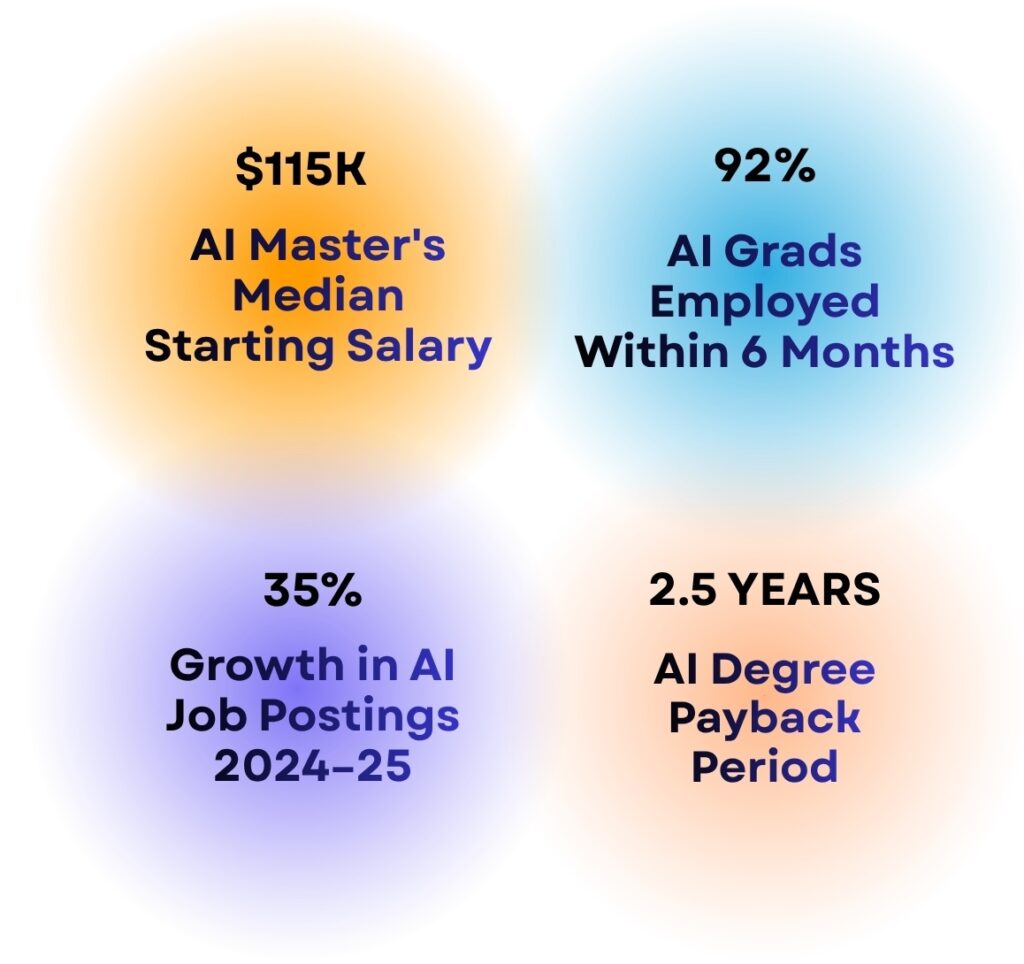
In 2026, an AI-focused master’s degree delivers significantly stronger financial ROI than most traditional master’s programs. AI graduates earn a median starting salary of $115,000–$120,000 and typically break even on their investment in 2.5 years, versus $90,324 median earnings and a 5–7 year payback window for the average traditional master’s. The financial gap widens further at the senior level, where AI specialists regularly earn $160,000–$210,000.
The calculus of graduate school has fundamentally changed. For decades, the MBA stood as the gold standard for career acceleration, and a master’s in computer science was the safe choice for technical workers. In 2026, a third category has emerged: the AI-specialized master’s degree with a financial case that is arguably the strongest of all three.
This is not simply a matter of a hot job market temporarily inflating salaries. The structural demand for AI professionals is deep and broadening. Deloitte’s 2025 AI report found that 74% of organizations expect AI to grow their revenue, yet named workforce skills as the single biggest obstacle standing in the way. When a skill is both strategically important and genuinely scarce, employers compete, and compensation reflects that competition.
This analysis examines the hard numbers: what each degree costs, what it pays, how quickly it recoups the investment, and which professionals are best positioned to benefit from each path:
What Does Each Degree Actually Cost in 2026?
Before comparing returns, you need to understand the investment side of the equation. Graduate tuition has risen sharply across all categories, but AI programs still offer a wide cost range that rewards strategic program selection.
| Degree Type | Low End | Median/Typical | Elite Programs |
| AI/Machine Learning MS | $35,000 | $55,000 –$75,000 | $90,000 –$120,000 |
| MS Computer Science (AI track) | $25,000 | $45,000 –$65,000 | $80,000 –$100,000 |
| MBA (full-time, 2 years) | $40,000 | $80,000 –$120,000 | $155,000 –$185,000+ |
| Traditional MS (avg. all fields) | $20,000 | $40,000 –$70,000 | $90,000+ |
The total two-year cost of attendance for a top MBA, including tuition, living expenses, and fees, averages approximately $242,267. Stanford’s MBA program carries a total cost of $271,542 for the 2025–2026 academic year, with Wharton’s two-year tuition alone reaching $184,560.
AI master’s programs, by contrast, are often one year in duration or available online, dramatically cutting both tuition costs and, critically, the opportunity cost of forgone income during enrollment. An online AI master’s program, averaging $55,000 in tuition, completed while working, represents a radically different financial exposure than a two-year residential MBA.
Key Cost Advantage
Many top-ranked AI master’s programs are available fully online from accredited research universities, allowing students to maintain their current income during enrollment. Georgia Tech’s MSCS with AI specialization, for example, carries one of the lowest tuition rates among top-20 programs. This income continuity dramatically compresses the effective cost of the degree.
Starting Salary Comparison: AI Master’s vs. Traditional Programs
The salary premium for AI expertise is not marginal. It represents a structural shift in how employers price specialized technical knowledge.
| Degree/Program | Median Starting Salary | Senior-Level Range | Top Programs |
| AI/Generative AI MS | $115,000–$120,000 | $160,000–$210,000 | $165,000+ (CMU) |
| ML Engineer (MS) | $165,000 avg. | $200,000+ in tech | — |
| MBA (all programs) | $125,000 (median) | $155,000–$215,000 | $169,370 (MIT) |
| MS Computer Science | $85,403 avg. starting | $145,080 senior avg. | $215,000 (Stanford AI/ML) |
| Traditional MS (all fields avg.) | $90,324 median | Varies widely | — |
| MBA (bachelor’s holders, no grad) | $77,636 median | — | — |
The most important comparison is not between AI master’s and MBA; it is between AI master’s and the overall average master’s. The Bureau of Labor Statistics data shows the typical master’s holder earns a median of roughly $90,324 annually. AI master’s graduates start at $115,000–$120,000 and, in specialized roles like machine learning engineering, $165,000 is a common pay rate. That’s a $25,000–$75,000 annual advantage from day one.
“When a skill is both strategically important and genuinely scarce, employers compete for the people who have it, and that gap widens at the mid-career and senior level.” Boston University, 2026
The MBA comparison deserves nuance. A top-tier MBA from Harvard, Stanford, or Wharton can produce starting salaries of $155,000–$175,000 in base compensation alone, plus signing bonuses of $25,000–$35,000. These programs remain competitive with elite AI degrees in terms of raw starting salary. The divergence appears in total investment required: those MBA programs also cost $250,000–$270,000 all-in, versus $60,000–$90,000 for many AI master’s programs.
The Payback Period: When Does Each Degree Break Even?
Payback period, which refers to the time it takes to recover total investment through salary gains, is where the AI master’s most clearly outperforms traditional alternatives.
Estimated payback period by degree type (years to break even):
| AI Master’s | ~2.5 years |
| MS Computer Science | ~3.5–4 years |
| MBA (mid-tier) | ~3–5 years |
| Traditional MS (avg.) | ~5–7 years |
Source: Education Data Initiative 2024; Research.com 2026 analysis
AI-focused master’s degrees typically break even within 2.5 years of graduation. This rapid payback is driven by the combination of strong starting salaries, high employment rates, and (in many cases) lower total tuition than competing programs. By comparison, traditional master’s programs take 5–7 years on average.
The MBA picture is more variable. Top MBA programs. particularly in M7 schools, can achieve breakeven in three to four years for graduates who enter consulting or finance. But mid-tier MBA programs, which charge $80,000–$120,000 in tuition yet produce starting salaries closer to $90,000–$105,000, may take seven to ten years to recoup the full investment.
The Opportunity Cost Factor
A full-time, two-year MBA means forgoing two years of salary — often $80,000–$120,000 per year for experienced professionals. When that opportunity cost is added to tuition, the total effective investment in a top MBA routinely exceeds $350,000–$400,000. AI master’s programs completed online while working carry near-zero opportunity cost.
This is the single most underappreciated factor in graduate school ROI calculations. The degree cost you see advertised is not the real cost you pay.
AI Master’s Salary by Role: What You Can Realistically Earn
The $115,000 median figure for AI graduates masks significant variation by role. Understanding which specific career paths the degree opens — and what they pay — is essential for accurate ROI modeling.
- Machine Learning Engineer: $165K+ avg. annual; up to $200K+ in tech
- AI Product Manager: $182K avg. annual compensation
- Generative AI Specialist: $160–210K mid-to-senior level range
- AI Research Scientist: $140–190K; varies by sector & experience
- NLP Engineer: ~$115K; avg. annual; growing rapidly
- AI in Healthcare / Imaging: $110–160K; high growth, clinical demand
Generative AI roles, in particular, have seen a 35% increase in job postings from 2024 to 2025 in the U.S. tech sector. Senior generative AI engineers and lead AI researchers — positions that typically require the depth signaled by a master’s degree — are commanding $200,000–$210,000 or more at large tech companies.
When a Traditional Master’s Still Wins on ROI
Intellectual honesty requires acknowledging the cases where a traditional master’s program remains the stronger financial choice. Not every professional benefits equally from an AI degree.
The Top MBA: Still Competitive for Specific Paths
An M7 MBA from Harvard, Stanford, Wharton, Booth, Kellogg, Columbia, or MIT Sloan remains one of the most financially defensible credentials available for professionals targeting consulting, private equity, or C-suite leadership. Stanford MBA graduates report total annual compensation approaching $215,000.
The MBA credential is also a hard filter for entry-level associate positions at McKinsey, Goldman Sachs, and comparable firms. No AI master’s changes that reality.
MS Computer Science: High ROI, Lower Specialization Risk
The Master of Science in Computer Science ranks among the top-ROI graduate degrees across all fields, with an estimated net lifetime value above $500,000 according to the Foundation for Research on Equal Opportunity (FREOPP). It is broader than an AI-specific degree, which matters for professionals who want flexibility across software engineering, AI, systems, and data roles.
MSN Nursing and Healthcare MS Programs
Advanced practice registered nurses (APRNs) with a master’s earn a median of $129,480 versus $96,000 for BSN nurses, with a $33,000+ annual premium against program costs of $40,000–$90,000. For the right candidate, this represents a payback period of three to five years and a lifetime premium worth several hundred thousand dollars.
The One Field Where the AI Premium Compressed
Data science is a cautionary tale. A decade ago, a master’s in data science commanded a significant premium over a bachelor’s degree. By 2025, the market had largely equalized: bachelor’s-level data scientists and analysts now earn salaries that nearly match what master’s holders commanded previously, compressing the premium to a statistically marginal 2.4% according to NACEWEB analysis. If you’re pursuing a pure data science master’s rather than an AI/ML-focused degree, model your ROI conservatively.
Employment Rates and Job Market Momentum
Salary is only one dimension of financial ROI — employment security and speed-to-job matter equally. Unemployment time erodes the return on any credential.
| Degree Type | Employment Rate | Time to Employment | Unemployment Rate |
| AI Master’s | 92% within 6 months | Often <6 months | Low (high demand) |
| MBA (all programs) | 80% within 3 months | ~3 months (top programs) | Low |
| Traditional MS (all fields) | Varies by field | Varies widely | 2.0% (master’s holders, BLS) |
| Stanford AI/ML MS | 94% offers within 3 months | <3 months | Near-zero |
AI master’s programs report a 92% employment rate within six months of graduation, reflecting sustained demand across technology and healthcare sectors. As of early 2026, LinkedIn listed over 2,800 open positions for Machine Learning Engineers alone across major employers, including Amazon, Netflix, TikTok, and Adobe. The World Economic Forum projects approximately 1 million new AI and machine learning positions globally over the next five years at a roughly 40% growth rate in these roles.
The 10-Year Earnings Projection: Building the Full Picture
Short-term salary comparison obscures the long-term wealth-building difference between degree types. The true ROI argument for AI degrees becomes even stronger when modeled over a full decade.
Cumulative earnings advantage: AI master’s vs. average traditional master’s (10-year projection)
AI master’s graduates earn approximately $115,000 in year 1 versus $90,000 for traditional master’s, with the gap widening to $165,000 vs $110,000 by year 10.
AI Master’s (median trajectory) Traditional Master’s (median trajectory)
Projections based on BLS, Research.com, and FREOPP data. Assumes 4% annual growth rate for both tracks.
Over a ten-year career, the difference in cumulative earnings between an AI specialist and an average traditional master’s holder can exceed $500,000 — even accounting for the higher potential cost of AI programs at elite institutions. This assumes conservative annual salary growth of around 4%, and does not include stock compensation or bonuses that are common in AI roles at technology companies.
The lifetime earnings comparison is even more striking. Master’s degree holders overall accumulate roughly $3.2 million in total career earnings versus $2.8 million for bachelor’s holders. AI specialists who reach senior roles at major technology firms — a realistic outcome for graduates of strong programs — can reach $200,000–$210,000 annually well before the midpoint of their career.
Which Professionals Benefit Most from an AI Master’s Degree?
The financial case for an AI master’s is compelling in aggregate, but the actual return depends heavily on individual circumstances. These are the profiles where the ROI is strongest:
Software engineers seeking a significant salary step-up
A software engineer earning $90,000–$110,000 who completes an AI master’s can realistically target $140,000–$165,000 in an ML engineering role — a $30,000–$55,000 annual increase. Against a $55,000–$75,000 tuition cost for an online program completed while working, the payback period is under two years.
Data analysts and scientists moving toward ML roles
Analysts and data scientists face increasing competition from bachelor’s-level hires. An AI master’s with depth in model development and deployment signals the additional capability that justifies significantly higher compensation. It also reduces the risk of wage compression that has already hit pure data science roles.
Business professionals targeting AI strategy leadership
Business-oriented AI master’s programs, such as Boston University’s MS in AI in Business or enterprise AI programs, target professionals who want to lead AI adoption rather than build the systems themselves. These graduates compete for AI product management and AI strategy roles where compensation frequently exceeds $150,000.
Career changers from non-technical backgrounds
Structured AI master’s programs designed for career changers, including bridge programs and applied AI tracks, offer a credible path for professionals without STEM undergraduate degrees. The credential provides the hiring signal that certifications and bootcamps typically cannot, which matters for breaking into roles with higher initial screening barriers.
Bottom Line: The Financial Verdict for 2026
An AI-focused master’s degree offers the strongest financial ROI of any graduate credential in 2026 for most technical and analytically-oriented professionals. The combination of a 2.5-year payback period, $115,000+ median starting salary, 92% employment rate within six months, and a 35% year-over-year increase in related job postings creates a compelling investment case that most traditional programs cannot match.
The exceptions, which point to a top MBA for consulting or finance and an MSN for clinical advancement, are real, but narrow. For the majority of professionals weighing a graduate degree in 2026, the question is not whether AI credentials outperform traditional ones on financial ROI. They do. The question is which AI program, at what cost, in what format best fits your specific career position and goals.
The traditional master’s still delivers lifetime value and job security. But if you are optimizing for financial return on investment, the data in 2026 points decisively toward AI.
Frequently asked questions
Is an AI master’s degree worth it financially in 2026?
Yes, for most candidates. AI master’s graduates earn a median starting salary of $115,000–$120,000 annually, with the degree typically recouping its full cost within 2.5 years. This rate is significantly faster than the 5–7 year payback period of a traditional master’s program. Employment rates are exceptionally strong at 92% within six months of graduation, and demand continues to grow at approximately 30% year over year for AI engineering roles.
How much more do AI master’s graduates earn compared to traditional master’s graduates?
AI master’s graduates earn roughly $25,000–$40,000 more per year at the starting level than the average traditional master’s holder. The median traditional master’s holder earns about $90,324 annually, according to BLS data. In contrast, AI master’s holders start at $115,000, and mid-career professionals in machine learning or generative AI roles frequently earn $160,000–$210,000. The gap tends to widen over time as AI expertise compounds into senior and leadership roles.
How long does it take for an AI master’s degree to pay for itself?
An AI-focused master’s degree typically reaches breakeven within 2.5 years of graduation, based on 2024 Graduate Program Cost Analysis data. Traditional master’s programs average 5–7 years. MBA programs at elite schools can achieve breakeven in 3–4 years for graduates entering high-paying fields like consulting, but mid-tier MBA programs may require 7–10 years when total investment is properly accounted for.
What is the average tuition cost for an AI master’s degree?
AI master’s degrees range from approximately $35,000 to $120,000 in total tuition. Online programs at public universities are typically $35,000–$60,000, while private institutions with strong research reputations charge $70,000–$120,000. Georgia Tech’s MSCS with AI specialization is one of the most affordable top-ranked options. Carnegie Mellon’s MS in Machine Learning, among the highest-ROI programs, commands premium tuition but reports average starting salaries of $165,000.
Should I get an MBA or an AI master’s degree?
It depends on your target role and career stage. If you are pursuing consulting, investment banking, or general management at a senior level, a top-10 MBA remains the stronger credential. If you are technical or analytical and targeting AI, machine learning, data engineering, or AI product management roles, an AI master’s typically delivers stronger financial ROI with a shorter payback period and lower total investment. For professionals targeting the intersection of AI and business strategy, business-oriented AI master’s programs (such as MS in AI in Business) offer an increasingly viable middle path.
Are online AI master’s degrees respected by employers?
Yes. Around 68% of U.S. employers value online AI master’s degrees equally to traditional in-person programs as of 2025, provided the degree comes from an accredited, reputable institution. Accreditation and university reputation remain the critical factors. Programs from research universities with strong AI faculty and industry connections, such as Georgia Tech, Northeastern, Carnegie Mellon, and Boston University, carry significant employer credibility regardless of delivery format.