
A comprehensive guide to understanding how artificial intelligence is reshaping academic decisions—and what students can do about it.
Introduction: A New Era of Academic Uncertainty
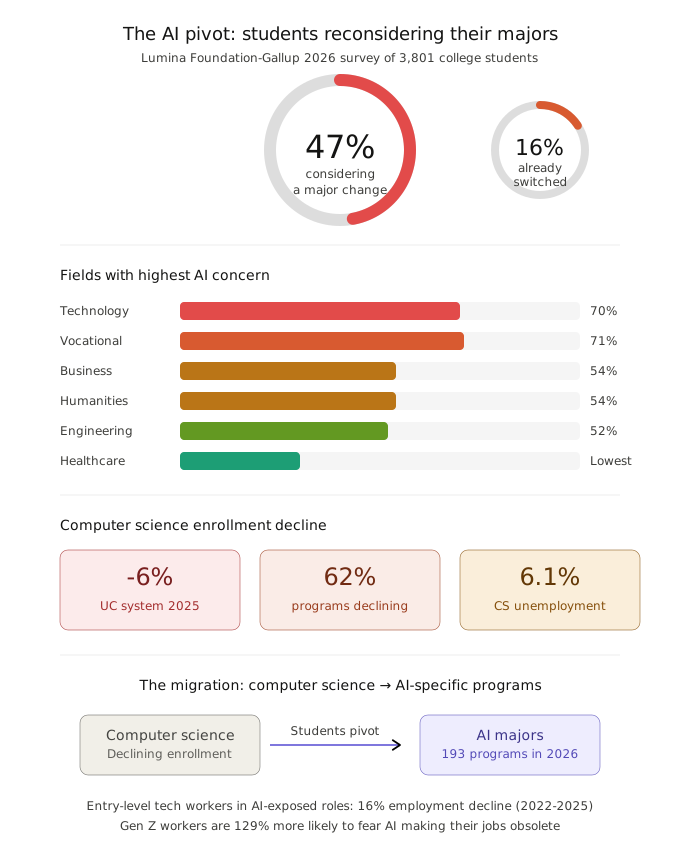
The rise of artificial intelligence has fundamentally altered the landscape of higher education and career planning. What was once considered a straightforward path—choose a major, earn a degree, land a job—has become a source of anxiety for millions of college students across the country. According to the Lumina Foundation-Gallup 2026 State of Higher Education Study, 47% of currently enrolled college students have thought “a great deal” or a “fair amount” about changing their major because of AI’s potential impact on the job market.
This unprecedented wave of academic reconsideration isn’t happening in a vacuum. It reflects genuine shifts in the labor market, declining enrollment in once-dominant fields, and growing uncertainty about which careers will remain viable in an AI-driven economy. For graduate school applicants and current students, understanding these dynamics is essential for making informed decisions about their academic futures.
The Data Behind the Trend
Nearly Half of Students Are Reconsidering
The Lumina Foundation-Gallup survey, based on web surveys conducted from October 2 to 31, 2025, with 3,801 adults pursuing associate or bachelor’s degrees, reveals striking statistics about student sentiment:
- 47% of all college students have considered changing their major due to AI concerns
- 56% of associate degree students have thought about switching, compared to 42% of bachelor’s degree students
- 16% of students report having already changed their major or field of study because of AI’s potential impact
- 14% of students say they’ve thought “a great deal” about changing their field of study, with an additional 33% saying they’ve thought “a fair amount”
Gender and Demographic Differences
The survey reveals notable differences across demographic groups:
- 60% of male students report thinking about switching majors, compared with 38% of female students
- Men are more likely than women to have actually changed majors due to AI (21% vs. 12%)
- Associate degree students are more likely than bachelor’s degree students to have changed their major (19% vs. 13%)
Fields Most Affected
Students in technology and vocational programs report the highest levels of concern:
- 70% of students in technology programs have given at least a “fair amount” of thought to changing majors
- 71% of students in vocational fields report similar concerns
- 54% of business and humanities students have considered switching
- 52% of engineering students have thought about changing their field
- Students in healthcare and natural sciences are the least likely to report switching due to AI
The Computer Science Exodus
Perhaps no field illustrates the AI-driven shift more dramatically than computer science—once considered the surest path to a lucrative career.
Enrollment Declines Across the Board
According to the Computing Research Association’s 2025 pulse survey of 133 academic units, 62% of respondents reported declining undergraduate enrollment in computing programs in the 2025-2026 academic year. The National Student Clearinghouse Research Center’s data confirms this trend, showing computer science enrollment declining across all institution types, ranging from a 3.6% drop at undergraduate primarily associate-degree granting institutions to a 14% drop at the graduate level.
The UC System Example
For the first time since the dot-com bust in the early 2000s, undergraduate computer science enrollment across the University of California system declined. System-wide enrollment fell 6% in 2025, on top of a 3% decline in 2024. This marks a dramatic reversal for a field that had seen more than a decade of rapid growth.
The only UC campus that bucked this trend was UC San Diego—notably, the sole campus to have launched a dedicated AI major.
Individual University Impacts
The enrollment shifts are visible at institutions across the country:
- At Arizona State University, computer science enrollment dropped from 5,844 in Fall 2024 to 5,008 in Fall 2025, while software engineering fell from 1,347 to 1,086 students
- At Washington University in St. Louis, the computer science major—once the largest on campus—is experiencing dramatic enrollment declines
- Teaching assistant positions in some programs have been cut significantly due to lower class sizes
Why Students Are Leaving CS
Several factors contribute to the exodus from traditional computer science programs:
- Job market concerns: Recent graduates in computer science and computer engineering have seen some of the highest unemployment rates among college majors, reaching 6.1% for CS graduates in 2025
- AI replacing entry-level work: Reports that AI can now write significant portions of code have made students question the value of programming skills
- Tech layoffs: Over 100,000 tech workers lost jobs in 2025, following more than 150,000 layoffs in 2024, creating a saturated market where experienced developers compete with new graduates
- Parental influence: Parents who once pushed children toward computer science are now steering them toward “harder” sciences like mechanical or electrical engineering
The Entry-Level Job Crisis
The anxiety among students isn’t unfounded. Entry-level positions—the traditional starting point for new graduates—are being disproportionately affected by AI automation.
Stark Employment Statistics
The unemployment rate for recent college graduates ages 22 to 27 ended 2025 at 5.6%, according to analysis by the Federal Reserve Bank of New York—well above the 4.2% overall rate and the highest December level for recent graduates since 2020. Among employed recent graduates, 42.5% were working in jobs that typically don’t require a college degree—the highest share since 2020.
Which Roles Are Most Vulnerable?
Research from multiple sources identifies several entry-level role categories facing significant AI-related disruption:
- Customer service representatives: Facing 80% automation risk by 2025, according to SSRN analysis
- Data entry clerks: Projected 7.5 million jobs eliminated by 2027
- Basic coding and software testing: Increasingly handled by AI tools
- Administrative support: Routine tasks being automated across industries
- Clerical work: Workers in AI-exposed clerical occupations experienced a 16% relative employment decline between 2022 and 2025
The Pipeline Problem
Harvard Business School’s Amy Edmondson notes that cutting entry-level jobs is short-sighted, as these positions are “crucial for developing future leaders.” This creates a concerning long-term dynamic: if entry-level roles disappear, the career ladder through which workers develop expertise is disrupted. Organizations risk a future shortage of senior talent who would have gained foundational experience in these now-automated roles.
Gen Z’s AI Anxiety
Young workers feel the pressure most acutely. According to National University data, workers aged 18-24 are 129% more likely than those over 65 to worry that AI will make their jobs obsolete. Additionally, 49% of Gen Z job seekers believe AI has already diminished the value of their college education.
Research published in Scientific Reports confirms that AI anxiety has a significant negative impact on career decisions among college students, affecting their ability to make clear and confident choices about their futures. The study found that AI anxiety undermines career adaptability—a critical psychological resource for coping with career challenges and uncertainty.
This anxiety is also affecting parents. A College Guidance Network survey found that two-thirds of parents say AI is impacting their view of the value of college. When asked to describe how they feel about the AI-driven future their teen will be entering, the words used most often were “concerned,” “cautious,” “uncertain,” and “worried.”
Fields Considered AI-Resistant
As students reconsider their academic paths, certain fields are emerging as perceived safe havens from automation.
Healthcare Professions
Nursing and other healthcare roles requiring direct patient care are widely considered among the most AI-resistant careers. While AI is increasingly used in healthcare for diagnostics, data analysis, and administrative tasks, the physical care, emotional support, and ethical judgment required of healthcare professionals cannot be replicated by machines.
According to a review published in the Journal of Medical Internet Research, AI holds substantial promise for revolutionizing nursing practice and education—but it serves as a tool to augment human capabilities rather than replace them. Nurses provide not just physical treatment but emotional support, which AI cannot replicate.
Skilled Trades and Physical Labor
Fields requiring physical presence and hands-on work are seeing renewed interest:
- Construction and skilled trades rank among the least vulnerable occupations to AI automation
- Mechanical engineering rose from 2,795 to 3,287 students at Arizona State from Fall 2024 to Fall 2025
- Electrical engineering increased from 2,825 to 3,252 students during the same period
- Personal service roles, such as food service workers, medical assistants, and cleaners, are less likely to be replaced
Psychology and Counseling
AI cannot truly understand human psychology or form the human connection necessary for therapists, counselors, and educators to impact their clients. While AI tools may assist with certain administrative aspects, the core work of mental health professionals—providing empathy, ethical judgment, and personalized care—remains distinctly human.
Education
While AI can assist with adaptive learning platforms and automated grading, classroom management and social-emotional teaching remain fundamentally human activities. Educators who focus on in-demand specialties such as English as a Second Language, early childhood education, and special education enjoy increased job security.
Performing Arts
Live performances cannot be replaced by AI, as the people doing the performance are the point. While AI may impact screen and voice acting, live theater, music, and stagecraft remain protected fields where human creativity and presence are essential.
The Rise of AI-Specific Degrees
While traditional computer science enrollment declines, AI-focused programs are booming.
Explosive Growth in AI Programs
As of 2026, there are 310 different AI master’s programs and 193 bachelor’s degree programs in AI across the United States—a dramatic increase from just 90 undergraduate AI programs in 2024. Bachelor’s degrees in AI have more than doubled in just two years.
The shift toward AI degrees is exemplified by SUNY Buffalo, where the AI master’s program grew from 5 students in 2020 to 103 in 2024—an increase of more than 20 times.
Universities Leading the Charge
Institutions across the country are rapidly expanding AI-specific offerings:
- Carnegie Mellon University: Launched the nation’s first Bachelor of Science in Artificial Intelligence in Fall 2018
- UC San Diego: The only UC campus with an undergraduate AI major, and the only one where enrollment increased
- MIT: AI and decision-making is now the second-largest major on campus
- University of South Florida: Debuted an entire College of AI and Cybersecurity in 2025, attracting over 3,000 students in a single semester
- University of Pennsylvania: Became the first Ivy League school to offer an AI-focused degree in 2024
- Drexel University: Launching an undergraduate degree in AI and Machine Learning beginning Fall 2026
- Kennesaw State University: Announced a new Bachelor of Science in AI launching Fall 2026
Why Students Are Choosing AI Over CS
Students see AI degrees as more targeted preparation for an AI-dominated job market. Those “who prefer to work with data to address problems find themselves more drawn to an AI major,” according to Asu Ozdaglar, deputy dean of academics at MIT’s Schwarzman College of Computing.
The appeal is clear: rather than learning general programming skills that AI tools may automate, AI majors focus on building and managing the AI systems themselves.
How AI Is Already Changing the Student Experience
AI isn’t just changing what students study—it’s transforming how they learn.
Widespread AI Use in Coursework
According to the Lumina-Gallup survey:
- 57% of students use AI weekly for their coursework
- 1 in 5 students use AI daily
- Even at schools where AI is prohibited, 10% use it daily and 17% use it weekly
The Skills Gap in AI Preparation
Despite widespread AI use among students, there’s a disconnect between institutional policies and student behavior:
- 42% of students say their colleges discourage AI use in coursework
- 11% say their institution prohibits AI use
- Only 7% say their college encourages students to use AI as much as possible
This creates a concerning skills gap. In 2024, 12% of students reported potential employers asking about their AI skills; by 2025, that figure hit 30%. Students at institutions that ban or discourage AI may graduate unprepared for workplaces where AI fluency is expected.
AI as an Enrollment Driver
AI isn’t just causing students to change majors—it’s influencing decisions about whether to attend college at all:
- About one in seven bachelor’s degree students (14%) and associate degree students (13%) say preparing for AI and other technological advances is an important reason they enrolled
- Similar shares cite concern about AI’s impact on the job market (12% in both groups)
Expert Recommendations for Students
Given the uncertainty surrounding AI’s impact on careers, experts offer several strategies for students navigating their academic choices.
Develop AI Fluency
Rather than avoiding AI, embrace it. According to a 2023 IBM global study, 40% of the workforce will need to reskill within just three years, mainly in entry-level positions. Students who gain AI fluency now will have a significant advantage over those who wait for formal training programs.
Practical steps include:
- Take online courses in AI tools and applications
- Learn to use ChatGPT, Claude, and industry-specific AI tools
- Document your AI usage and results for your resume
- Understand how automation workflows are built, even if you’re not a programmer
Focus on Human-Centric Skills
McKinsey’s Generative AI and the Future of Work in America report found that individuals who exhibit strengths in “adaptability, coping with uncertainty, and synthesizing information” are more likely to be employed and earn higher incomes in the future.
Skills that remain difficult for AI to replicate include:
- Strategic thinking and complex decision-making
- Creative problem-solving
- Emotional intelligence and empathy
- Negotiation and relationship-building
- Ethical judgment
Consider Interdisciplinary Approaches
Rather than choosing between traditional majors and pure AI programs, consider interdisciplinary pathways. Many experts recommend “stacking” skills—combining domain expertise with AI/data literacy.
For example, a nursing student who also gains AI fluency could be positioned to work on AI-powered healthcare tools. An education major who understands AI could help develop adaptive learning systems.
Evaluate Career Resilience
Before committing to a major, ask critical questions:
- Does this career rely on emotional intelligence, creativity, or human judgment?
- Does it require physical presence or hands-on interaction?
- Is AI a tool in this field—or a threat?
- Are there long-term growth opportunities in this industry?
Careers linked to public health, AI ethics, sustainability, and digital education are all gaining momentum.
Build Career Adaptability
Research shows that career adaptability is a key mediator in how AI anxiety affects career decisions. Building adaptability involves:
- Assuming your current skills have a limited shelf life and planning to continuously learn
- Building a professional network that can help you navigate transitions
- Exploring multiple career paths rather than putting all eggs in one basket
- Developing the psychological resilience to handle uncertainty
The Bigger Picture: Net Job Creation
Despite the anxiety, many projections suggest AI will create more jobs than it eliminates—though the transition will be challenging.
Projected Job Growth
According to the World Economic Forum’s Future of Jobs Report 2025, 170 million new jobs will be created by 2030, while 92 million will be displaced—a net gain of 78 million positions. This represents one of the largest employment transformations in modern history.
However, the new jobs aren’t one-to-one replacements. They often:
- Aren’t in the same locations
- Don’t require the same skills
- Won’t automatically go to displaced workers
Emerging Career Opportunities
Several fields are expected to see significant growth:
- AI and data science specialists: Among the fastest-growing job categories in 2025
- Cybersecurity professionals: Information security analyst roles expected to grow 32% from 2022 to 2032
- Renewable energy technicians: Solar photovoltaic installers expected to grow 22%, wind turbine technicians 44% from 2022 to 2032
- Healthcare workers: Continued strong demand due to aging populations
- AI trainers, ethicists, and explainability experts: New roles created by AI adoption
The Wage Premium for AI Skills
Workers with AI skills command a significant wage premium—approximately 56% higher than non-AI jobs, according to multiple sources. This suggests that the path forward isn’t avoiding AI, but learning to work alongside it.
What Colleges Are Doing
Higher education institutions are responding to these shifts in various ways.
Curriculum Updates
Universities are racing to add AI-related content across disciplines. A New York Times article in December 2025 noted that colleges nationwide are rapidly expanding AI-driven programs as student demand surges and employers seek graduates with both technical fluency and interdisciplinary training.
Many institutions are rethinking the structure of their computer science departments to accommodate new AI-focused pathways and research directions.
New Departments and Programs
Beyond individual courses, entire academic units are being created:
- Johns Hopkins University announced major new initiatives in AI
- SUNY Buffalo created a standalone “Department of AI and Society” offering interdisciplinary degrees
- Columbia University, Pace University, and New Mexico State University are all launching AI degrees
- Colby College launched the Davis Institute for Artificial Intelligence, integrating AI education across fields from computer science to humanities
Faculty Challenges
The rapid expansion creates challenges. Faculty shortages are common, with demand for AI professors outstripping supply. Some schools are turning to industry adjuncts, though critics argue this could dilute academic rigor.
Conclusion: Navigating Uncertainty with Purpose
The rise of AI has created genuine uncertainty for college students—uncertainty that is driving nearly half of them to reconsider their academic paths. The data is clear: students are anxious, entry-level jobs are being disrupted, and traditional pathways to career success are being questioned.
But uncertainty also creates opportunity. Students who develop AI fluency, build human-centric skills, and cultivate adaptability will be well-positioned for whatever the future holds. The key is approaching these decisions with intention rather than panic.
For graduate school applicants specifically, this landscape suggests several considerations:
- Programs that integrate AI literacy with domain expertise may offer the best preparation
- Fields requiring human judgment, creativity, and physical presence remain strong choices
- The ability to work with AI—rather than being replaced by it—should be a central career consideration
- Continuous learning and adaptability will be more important than ever
The world is changing rapidly, and the students who thrive will be those who view AI not as a threat to be avoided, but as a tool to be mastered.
Sources
- Lumina Foundation-Gallup 2026 State of Higher Education Study
- Computing Research Association CERP Pulse Survey 2025
- National Student Clearinghouse Research Center Final Fall Enrollment Trends 2026
- Federal Reserve Bank of New York Labor Market Analysis
- World Economic Forum Future of Jobs Report 2025
- Journal of Medical Internet Research – AI in Nursing Education
- Scientific Reports – The Impact of AI Anxiety on Career Decisions
- U.S. Bureau of Labor Statistics Employment Projections
- Goldman Sachs AI Workforce Analysis
- McKinsey Global Institute Reports on AI and Employment
- San Francisco Chronicle / UC System Enrollment Data
- Arizona State University Enrollment Statistics
- Washington University Student Life
- Inside Higher Ed
- Axios
- The Hill
- TechCrunch
- CNBC
- New York Times
This article was prepared for GradSchoolCenter.com to help prospective and current graduate students navigate the rapidly evolving landscape of higher education in the age of artificial intelligence.